Blog
 Tue, 12 May 2026 11:21:55 GMT by Silver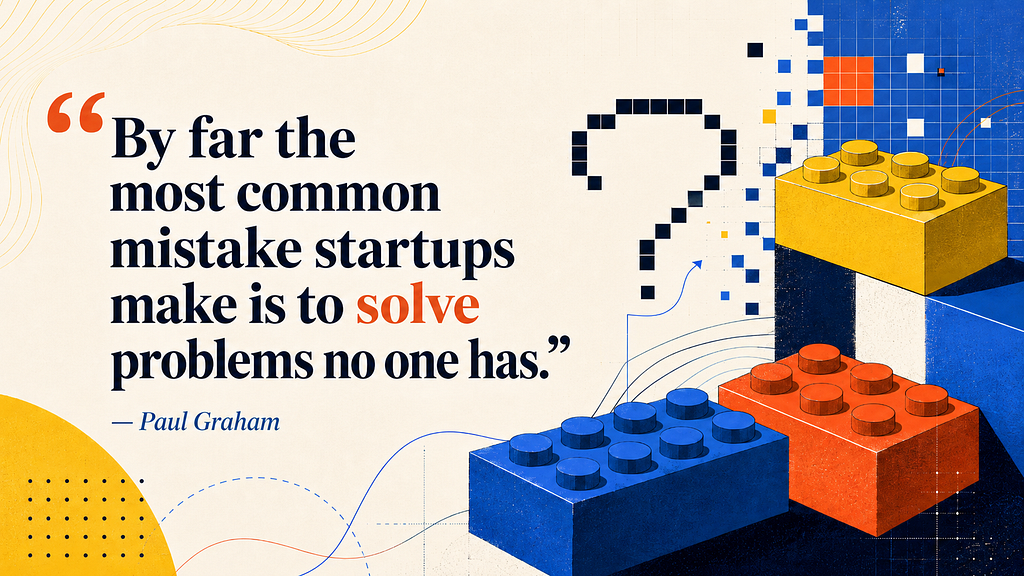
Most AI builders today will gladly build whatever you ask. Fast. The code is clean, the app runs, the deploy is one click.
That’s the trap. You get exactly what you asked for. What it isn’t is what the market actually wants.
Because the real reason startups die isn’t ugly code. It’s that nobody wanted the thing in the first place. AI just made it cheaper and faster to build the wrong thing.
Two of the people who know this best said it plainly.
“By far the most common mistake startups make is to solve problems no one has.”
— Paul Graham, founder of Y Combinator, in How to Get Startup Ideas
“We must learn what customers really want, not what they say they want or what we think they should want… The big question of our time is not Can it be built? but Should it be built?”
— Eric Ries, The Lean Startup
The numbers back them up:
- ~90% of startups fail within their first few years (Startup Genome)
- 43% of failed startups cited “poor product-market fit” as a top reason (CB Insights, 2026 — up from the original 42% figure first published in 2014)
- $10K to $150K+ is the typical MVP development cost, with $40K–$80K being the average for a web app and $60K–$150K for mobile (industry surveys, 2025–2026)
- 18 to 24 months is the average time first-time founders take to find product-market fit, if they ever do (Y Combinator, Stripe)
Almost half of all dead startups spent a year or more, and tens of thousands of dollars, building something nobody asked for. The technical work was fine. The market was the problem.
The old fix: venture studios
Smart people figured this out decades ago. The fix has a name: a venture studio. Sometimes called a startup studio, a company builder, or an incubator. Think Y Combinator, Atomic Labs, or Idealab, which has been doing this since March 1996, when Bill Gross founded it as the first true startup studio.
A venture studio is a small team of specialists who do the work for you:
- Pressure-test the idea against the real market before a line of code is written
- Design a brand, name, and landing page
- Write the ad copy and run the ads
- Find the first real customers through cold outreach
- Read the numbers and tell you what to build, what to drop, what to charge
- Help you ship the first version of the actual product
It works. Per the Global Startup Studio Network, 72% of studio-built companies reach Series A, versus 42% of traditional VC-backed startups. Studios reach Series A in 25 months on average, versus 56 months the traditional way. Studio-backed companies show a 53% average IRR versus 21.3% elsewhere.
That’s the good news.
The catch
The bad news is everything else about how venture studios work.
- $200K–$5M+ is what a studio sinks into each company in salaries, design, ads, infrastructure, and overhead. GSSN data: median annual studio budget $1.36M, average $2.49M, split across a small handful of new companies per year. The selection floor for GSSN-included studios is “$200K+ per company.”
- 30–50% equity the studio takes for that work, average from the GSSN survey: 34%. For comparison, traditional VCs take 10–20% at the same stage.
- ~1–2% of applicants are accepted by top-tier studios and accelerators. Y Combinator gets 20,000 to 40,000 applications per batch and admits roughly 1–2% of them.
- Months of interviews, screenings, and partner meetings before you get an answer.
- One city you usually have to move to: San Francisco, New York, London, Paris, Berlin.
In plain words: you have to live in a major hub, win a contest most people lose, and even if you win, you walk away owning half of your own company.
For the other 98% of founders, that door is closed.
There is a better way
The studio model is right. The way it’s delivered is wrong.
The work a venture studio does (research, branding, page, ads, outreach, analytics, planning) is mostly the same job done over and over on a different idea each time. That kind of work is exactly what a careful AI team is good at. Not the dreaming up of the idea. The grinding through of every step that comes after it.
That’s why bl0x exists. bl0x is an AI venture studio. Same job as Atomic or Idealab. No equity. No application. No moving cities. You keep 100% of your company. Free to start.
Anyone with an idea can start one in under a minute.
What your AI team actually does
You type one sentence describing your idea. Your AI team takes it from there.
None of this is improvised. Every piece (the name, the headline, the ad hook, the pricing layout, the cold email opener) is written using methods that already won:
- Eric Ries, The Lean Startup for what to test first
- April Dunford, Obviously Awesome for how to position
- Robert Cialdini’s persuasion principles for the copy
- Jobs-to-be-Done (Clayton Christensen, Tony Ulwick) for the value prop
The agent has studied thousands of real-world wins and failures and applies the patterns automatically. You get the distilled lessons of a decade of startup writing on day one, without having to read the books.
Hour 1: A real website
Within an hour you have a working landing page on its own link, with a brand, a hero, a name, and a signup form. Not a template. Every page is written from scratch for your specific idea, with six different headline variants running against each other so you find out which words actually work.
Day 1: Real strangers show up
Six ad variants go live across Facebook, Instagram, Threads, Meta Audience Network, and Reddit. The agent writes the copy, makes the images, picks the targeting.
Targeting is the boring word for “deciding who sees the ad.” A 19-year-old in Lagos and a 52-year-old plumber in Ohio don’t need the same pitch. The agent picks countries, cities, ages, jobs, interests, the right subreddits, the right time of day. Tight interest groups. Not the “everyone aged 18 to 65” trap that kills most beginner campaigns.
In parallel: cold outreach. The agent finds real people in your industry, verifies their email addresses (so you don’t look like a spammer), writes a short, personal message for each one, and lands them in real inboxes. Real replies come back to you.
Every click, scroll, signup, and reply is measured.
Day 3: What to build next
Anybody can run an ad. The hard part is reading the result and knowing what to do next. This is where most founders get stuck, and this is what bl0x was built for.
Your AI team reads every page view, every scroll, every signup, every reply, every ad click, side by side with the words it tried. And it asks the small useful questions that win or lose a startup:
- Which headline made strangers stop and read?
- Which Reddit community sent the most signups per dollar?
- Where on the page do people scroll past and leave?
- Which pricing version made people click “Start”?
- Which outreach line got real replies and which got silence?
Every cycle, the agent doubles down on what works and quietly drops what doesn’t. The winning headline becomes the new baseline. The audience that paid becomes the main target. The feature everyone clicked on goes to the top of the backlog. The one nobody noticed gets cut.
The goal is one thing only: real market signal. Not opinions from friends. Not survey scores. Real numbers from real strangers. CTR, CPC, signups, page reads, scrolls, replies.
After 72 hours you don’t have a guess. You have a verdict. And a clear path: another sharper validation round, or your AI team starts shipping the features that won.
Your own private workshop
Every project lives in its own sealed sandbox. Other users cannot see in. The agent works inside that room and only that room.
What that room gives you, all included:
- Your own database, set up automatically
- Real internet access (Stripe, email, any service on the web)
- Install anything on the spot
- Version history built in (roll back any time, like a video game save point)
- No lock-in. The code, the page, and the data are yours. If you ever want to leave, you take it with you.
- The full Claude model family. Heavy thinking for hard problems. Fast models for small ones.
That’s what lets the AI team do more than just print a landing page. It can ship real features for your first real customers. Login screens. Payments. Bookings. Dashboards. The stuff that turns a page with a signup form into an actual product.
One dashboard, two of you running it
Every project gets its own dashboard. Your numbers, your page, your ads, your replies, your backlog, your plan, all in one place. It’s yours, but you’re not the only one using it. Your AI team works inside it next to you.
Type one line to change the headline, run a new ad angle, write to a new batch of leads, or ship a new feature. It does the work. You read the result. The dashboard is the desk where the two of you meet.
The short version
- Most startups die because nobody wanted the product (CB Insights: 43%)
- Venture studios solve that, but they spend $200K to $5M+ per company and take 30 to 50% equity in exchange (GSSN)
- bl0x is the same job, done by AI, for everyone
- One hour to a real website. Three days to a real verdict. Then your AI team helps you ship the actual product
- You keep 100% of your company. Free to start
So go to http://bl0x.io to get an AI team that builds your startup.
Sources
All claims above are drawn from the following publicly available sources. Search any of these by name to verify.
- Paul Graham, How to Get Startup Ideas (November 2012), paulgraham.com essays.
- Eric Ries, The Lean Startup: How Today’s Entrepreneurs Use Continuous Innovation to Create Radically Successful Businesses (Crown Business, 2011).
- Startup Genome annual reports on startup failure rates. Also: Shikhar Ghosh, Harvard Business School (2012) on venture-backed cash-return rates.
- CB Insights, The Top 9 Reasons Startups Fail (originally Top 20 Reasons Startups Fail). 2014 report cited 42% for “no market need”; 2026 update of 385 companies puts poor product-market fit at 43%.
- MVP development cost ranges from industry surveys, 2025–2026 (Ideas2IT, American Chase, SoftTeco, Ptolemay, and other consultancy breakdowns).
- Time to product-market fit research. Y Combinator data and Stripe co-founder John Collison interviews. Multiple practitioner accounts (Real Founder Lessons, GroundControl, Y Combinator Library) converge on 18 to 24 months.
- Idealab founding history. Founded March 1996 by Bill Gross. 150+ companies built, 7 with billion-dollar exits. The first true startup studio.
- Global Startup Studio Network (GSSN), Disrupting the Venture Landscape white paper and 2022 Data Report. Survival, IRR, and Series A graduation comparisons (72% vs. 42%, 25 vs. 56 months, 53% vs. 21.3% IRR). Median annual studio budget $1.36M, average $2.49M.
- Venture studio equity stake research. GSSN survey: 30–50% range, 34% average. Compared with 10–20% for traditional venture capital at comparable stage. (Esinli, Mandalore Partners, Focused Chaos: Venture Studio Math.)
- Y Combinator acceptance rate analysis. 20,000–40,000 applications per batch, 250–400 admitted, ~1–2% acceptance rate. (Zyner, Leland, multiple practitioner write-ups.)
- April Dunford, Obviously Awesome: How to Nail Product Positioning so Customers Get It, Buy It, Love It (Ambient Press, 2019).
- Robert Cialdini, Influence: The Psychology of Persuasion (Harper Business, 1984; expanded edition 2021).
- Jobs-to-be-Done framework. Clayton Christensen et al., Competing Against Luck: The Story of Innovation and Customer Choice (HarperBusiness, 2016). Tony Ulwick, Jobs to be Done: Theory to Practice (Idea Bite Press, 2016).
This article originally appeared in https://x.com/sgraphics8/status/2054135919045673116













We use AI extensively: ideating tokenization concepts, designing workflows, modelling scenarios, and generating documentation. AI gives us speed and range that manual consulting alone can't match.
For the actual smart-contract code, we take a different approach: contracts are composed from pre-verified, audit-ready building blocks rather than AI-generated. Think of it as Lego: each block is hand-crafted and tested; AI helps you decide which blocks to use and how to arrange them. This gives you the best of both worlds: AI-driven speed for design, and deterministic safety for the code that holds real value on-chain.
Toolblox offers the flexibility traditionally found in custom development combined with the ease of no-code platforms.
Smart-contract templates, while seemingly convenient, often don't cater to all asset classes or jurisdictions, can stifle business process innovation, and become costly when adapting to specific needs due to re-audit requirements. Custom smart-contract development, on the other hand, is a lengthy and expensive process, requiring specialized skills, and the auditing phase is both costly and time-consuming.
Toolblox composes smart contracts from pre-verified modules. You get a solution tailored to your specific asset, jurisdiction, or business nuance, all while being cost-effective to audit and easy to understand through visual workflows.
You do. You can export the full Solidity source code, auto-generated documentation, and integration specs at any time. Once deployed, the smart contract and its data are entirely yours, with no lock-in or dependency on Toolblox to operate.
Yes. Many teams start with the Smart-Contract Builder to explore workflows and prototypes, then bring in a Tokenization Sprint when they need a full blueprint, spec and rapid prototype for a specific deal structure. Everything you build in the self-serve tool carries forward.
Tokenization transforms traditional business protocols into self-executing smart contracts, streamlining operations and ensuring clarity.
- Efficiency in Operations: Self-executing contracts automate processes, speeding up operations like reconciliation, administration and settlement.
- Reduced Miscommunication: With every term and condition explicitly coded, there's less room for misunderstandings or disputes.
- Clarity in Business Protocols: Tokenized assets come with predefined rules and protocols, making business operations clearer and reducing ambiguities.
- Liquidity: Assets, even traditionally illiquid ones like art or real estate, become easily tradable, enhancing their accessibility.
- Fractional Ownership: Tokenization divides assets into smaller units, allowing more investors to partake in high-value asset ownership.
- Transparency: Every transaction is transparently recorded on the blockchain, ensuring verifiability by all stakeholders.
- Security: Blockchain's robustness safeguards tokenized assets, minimizing fraud risks.
Integrating smart-contract workflows is straightforward with Toolblox. While there are standard methods like using JavaScript web3 libraries, we offer a user-friendly DApp builder that allows you to embed smart contract actions directly into your solution.
Additionally, for those who prefer no-code platforms, we provide an open API and plugins, including compatibility with popular platforms like Bubble. This ensures a seamless integration tailored to your business needs.
Yes. Toolblox is designed so that non-technical stakeholders can use AI to generate visual workflows and review blueprints. Technical teams can then refine the workflow and export source code.
For the Tokenization Sprint, you only need to describe your deal logic and we handle the rest, delivering a reviewable spec and working prototype.
Cross-workflow calling is built into the builder. Any workflow can call any other workflow, enabling complex multi-asset scenarios and DeFi integrations.